How We Helped Vedic Aura Scale Meta Ads From ₹4.8 Lakh to ₹13 Lakh a Month (Without Losing Profitability)
A Vedic Aura case study by Adymize | Lifestyle & Wellness | Meta Ads
Table of Contents
- Where Vedic Aura Stood Before We Started
- The Real Problem: Not Enough Room to Grow
- What We Changed: Creatives and Offers Working Together
- How the Three Months Played Out
- The Results, Side by Side
- What Didn’t Work (And Why We’re Sharing It)
- What Other Brands Can Take From This
- Final Thoughts
Where Vedic Aura Stood Before We Started
Plenty of agencies like to showcase rescues of struggling accounts. This case is a different kind.
Vedic Aura was already in good shape when they approached us. Their Meta Ads were bringing in sales consistently and staying profitable, backed by a creative approach and a customer-acquisition routine that suited the brand. Monthly ad spend sat near ₹4.87 lakh and produced about ₹11.5 lakh in revenue, so each rupee put in brought back roughly ₹1.4.
So where was the trouble?
Raising the budget never held up. More spend didn’t buy proportionally more customers; it bought fewer of them, at higher prices. Brands in this position know the feeling well: the demand clearly exists, yet reaching it keeps getting costlier.
Our brief, then, was never to repair the ads. It was to help the brand grow without disturbing what was already working.
The Real Problem: Not Enough Room to Grow
A closer look at the account made one thing obvious early on. Vedic Aura didn’t lack budget. It lacked the space for that budget to perform.
Several factors were limiting growth.
Too few creatives to carry bigger spend. The existing ads did their job at a modest budget, but the account lacked the variety of ideas, formats and angles needed to carry far more spend. Put heavy money behind a handful of ads and the same audience keeps meeting the same message.
Creative fatigue was setting in. Repetition wears people out. They scroll past ads they recognise, interest falls, and every sale gets pricier. A limited set of creatives tires quickly, and bigger budgets speed that up.
The offer left money on the table. Nothing in the existing offers nudged shoppers to add more to their cart. When each order is worth more, there is more cushion for what it costs to win a customer, and that cushion was going unused.
Scaling would have meant trading efficiency for growth. Had we simply raised the budget and left the other three issues alone, revenue might have climbed for a month or two before profits slid.
Our goal was not bigger spend for its own sake, but an account that could handle bigger spend sensibly.
What We Changed: Creatives and Offers Working Together
Many brands manage creatives and offers separately: one person tests ads, another sets discounts, and the two rarely compare notes. We joined them into a single loop in which each side strengthens the other.
The reasoning is straightforward. A wider range of creatives gives more shots at finding what appeals to people. Better offers make it easier for those people to buy. More purchases leave more room to scale, and a larger scale teaches us still more.
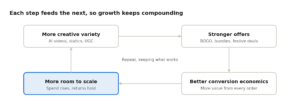
Follow the arrows clockwise: each step eases the next, and the final one gives the account fresh space to begin the cycle again.
In practice, it came down to the following.
Widening the creative pool with AI-generated videos
We began making video ads with AI tools, mainly for the speed and range they offered. Rather than waiting weeks on one polished shoot, we could test plenty of hooks, visuals and storylines fast, watch how people responded, and build more of whatever worked.
Keeping static posters in the mix
Simple image ads stayed too. Static posters ran next to the videos and, frankly, did well: they were cost-efficient, quick to produce, and gave the account a different look, which helps fight ad fatigue. Some people just don’t want to watch a video, and a strong poster still gets the message across.
Bundles and combos that make buying more feel natural
The second major piece was a set of offers meant to lift order value without feeling forceful:
- BOGO and quantity-based deals, giving shoppers a reason to buy more than one.
- A pack of 3, designed mainly for retargeting. A visitor who has browsed or added something to the cart is much more willing to take a larger pack when the deal feels fair.
- A ₹1,299 bundle pairing the product with a bracelet. It came across as a gift-ready set instead of a plain discount, a good match for a lifestyle and wellness brand.
Using festivals the right way
Festive moments move Indian shoppers, and Vedic Aura’s products suit them naturally. Instead of starting over, we placed seasonal offers on top of the creatives and bundles that had already proved themselves. For Raksha Bandhan we ran a one-day sale with a lower product price. As the festive offers revealed which combinations worked, we shifted budget toward them.
How the Three Months Played Out
None of it happened in a day. We worked in stages, and every month built on the lessons of the one before.
Month 1: Laying the foundation
Month one was about assembling a fresh set of creatives. We added UGC-style videos and several static image variations, then tested different angles to learn which messages connected. By the month’s end a few patterns were showing, which gave us firm footing for what came next.
Month 2: Building on what worked
Once early winners emerged, we leaned into them. We widened the formats that worked, added AI-generated videos and statics, and put more budget behind the combinations that had proved themselves. This was when the account began to feel different: there was more to draw on, and spend could grow without everything wobbling.
Month 3: Turning it into a routine
By month three we had a routine instead of a string of experiments. Creatives kept getting refreshed, budget flowed toward the strongest combinations, and money moved away from anything losing steam. We aimed for more volume while guarding efficiency. BOGO and the festive offers arrived here as well, and gave growth an extra lift.
Spend grew steadily through this period. Here is how monthly spend climbed.
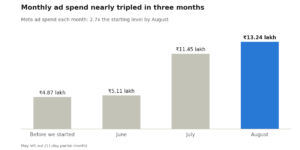
The sharpest rise came between June and July, when spend more than doubled as the new creatives and offers were ready to support it.
The Results, Side by Side
Here is the account before we began, next to where it stands today.
| What we looked at | Before | After |
|---|---|---|
| Monthly ad spend | ₹4.87 lakh | ₹13.24 lakh |
| Return on ad spend | 1.4x | 2.0x |
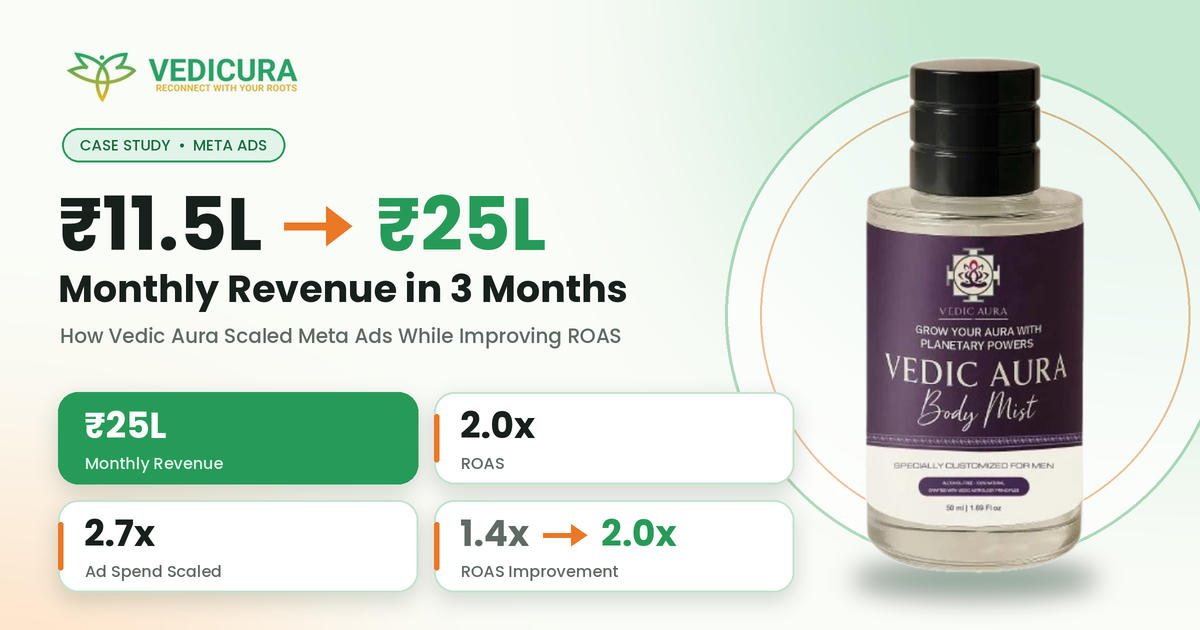
| Monthly revenue | ₹11.5 lakh | ₹25 lakh |
Spend almost tripled and revenue more than doubled. Even as the budget grew, the return on each rupee improved from 1.4x to 2.0x instead of slipping.
That final point matters most to us. Spending more on ads is easy. Spending more while every rupee works harder than before is the difficult part, and it’s what turned a profitable account into one with room to keep growing.
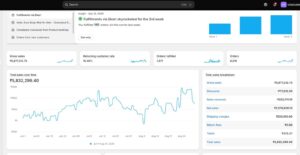
Want to check it yourself? We’ve added screenshots from the Meta dashboard and the brand’s own backend, so the results don’t depend only on our word.
What Meta Ads Manager shows
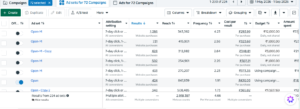
Ad sets across 72 campaigns, from 1 May to 1 September 2026, with purchases, reach and cost per purchase side by side.
What the store’s own backend shows
What Didn’t Work (And Why We’re Sharing It)
We could have skipped this section, but a case study made only of wins isn’t much help, so here is the candid part.
Professionally produced UGC-style videos didn’t perform as well as we expected.
These ads were produced well and looked likely to succeed. Yet the AI-generated videos and the plain static posters beat them.
The lesson was that polish doesn’t drive purchases. Relevance, format and the strength of the offer counted for more. For this audience, a slick look wasn’t what decided things.
So we did the sensible thing: we stopped funding the costly, production-heavy creatives and moved that money to the formats genuinely delivering. It cut costs and gave the stronger performers more room.
Not every idea wins. What matters is spotting that quickly and not clinging to something just because it took effort to build.
What Other Brands Can Take From This
Each brand is different, yet a few lessons from this project apply widely.
- If scaling hurts your results, look at your creatives first. Often the real problem is too few ads being asked to carry too much.
- Keep a steady flow of new ideas. Fatigue is normal. The fix is to keep refreshing, not to hope it never arrives.
- Let your offer do some of the heavy lifting. Bundles, combos and gifting sets raise the worth of each order and make costs easier to handle.
- Use festivals thoughtfully. Layer seasonal offers over what already works instead of reinventing things every time.
- Don’t confuse expensive with effective. Often the simpler ad that is faster to make is the one that wins.
- Be willing to drop what isn’t working. Shifting budget quickly accounts for a large part of the outcome.
You May Also Like:
What is Performance Marketing & How It Works in 2025-26
Final Thoughts
Vedic Aura already had something good. What it needed was a way to grow it without breaking it.
By broadening the creatives, shaping offers that gave shoppers a reason to buy more, and moving budget fast toward what worked, monthly spend rose from about ₹4.87 lakh to over ₹13 lakh while return on ad spend climbed from 1.4x to 2.0x.
No single trick did it. It was a steady cycle of trying new ideas, keeping the good ones, dropping the rest, and starting again.
If your Meta Ads are doing fine but stall whenever you try to scale, we may be able to help. We’d be glad to talk it through.