How Grosyhub Grew From ₹7 Lakh to ₹38.6 Lakh a Month on Meta Ads in Just 5 Months
A Grosyhub case study by Adymize | D2C Dropshipping | Meta Ads (Facebook & Instagram) | 5-month engagement
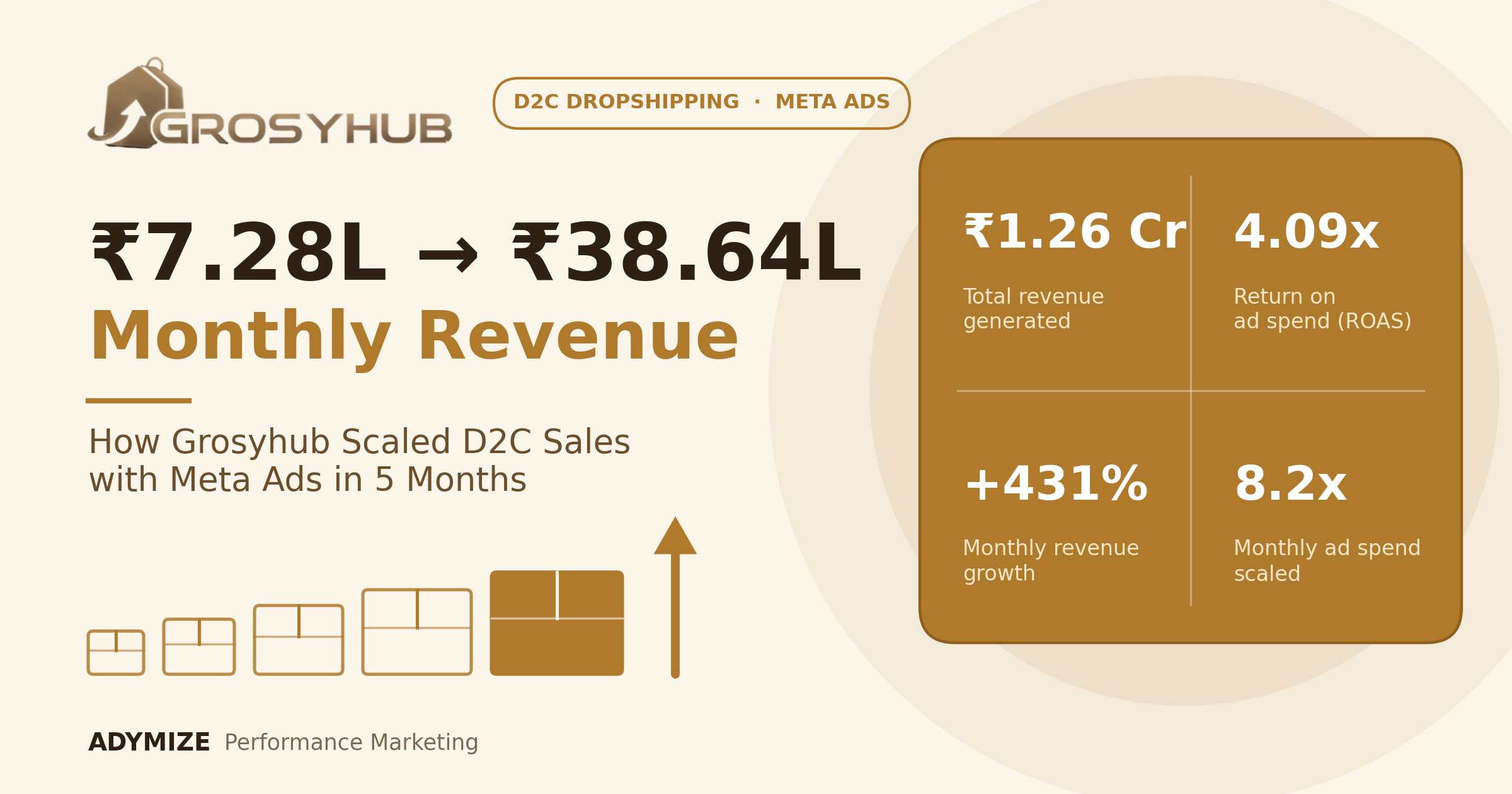
Grosyhub was doing fine. Ads were running, orders were coming in, and the team was busy. But the account had settled at around ₹7 lakh a month and refused to move. In five months, with a different way of working, it reached ₹38.6 lakh a month and brought in ₹1.26 crore in total revenue at a 4.09x return on ad spend. This is that dropshipping Meta Ads case study, told honestly, including the tests that failed.
Table of Contents
- Where Grosyhub Stood Before We Started
- What Was Holding the Account Back
- Our Approach: The Creative-to-Scale Framework
- How the Five Months Unfolded
- The Results, Before and After
- The Proof Behind the Numbers
- What Didn’t Work
- Lessons for Dropshipping and D2C Brands
- Final Thoughts
Where Grosyhub Stood Before We Started
Before we came in, Grosyhub’s team ran its Meta Ads in-house. There was no media-buying partner, and nobody whose full-time job was growing the account. Budgets were kept cautious, and there was no set process for testing new ideas or scaling the ones that worked.
The result was a comfortable plateau. Here is exactly where things stood on day one:
| Where the account stood | Number |
|---|---|
| Monthly ad spend | ₹1.82 lakh |
| Platform ROAS | 3.60x |
| Average order value | ₹410+ |
| Monthly revenue | ₹7.28 lakh |
These weren’t bad numbers. That is exactly what made the situation tricky. When an account is making money, there’s little pressure to change anything. But growth had stalled, and the team’s effort wasn’t turning into bigger results.
What Was Holding the Account Back
Our first audit made one thing clear. This was not a “spend more” problem. It was a structural one. We found seven separate issues that were keeping the account from scaling profitably.
No scaling framework. Budgets went up whenever someone felt like it, with no structure behind the decision.
Narrow audiences. Targeting was defined too tightly. That capped reach and pushed frequency up, so the same people kept seeing the same ads.
Creative fatigue. A small, ageing set of creatives was being shown over and over to the same pools of people.
Tracking and pixel problems. Signal was being lost along the way, which distorted both optimisation and reporting.
No Conversions API (CAPI) setup. The account relied only on browser-side pixel data, so a chunk of real revenue went unattributed and Meta’s system had less to learn from.
One product carrying everything. Revenue leaned heavily on a single hero product. That made the business fragile and set a low ceiling on growth.
Too little creative testing. New ideas weren’t being tested often enough to reliably turn up fresh winners.
None of these is dramatic on its own. Together, they explain why more effort wasn’t producing more results.
Our Approach: The Creative-to-Scale Framework
We rebuilt the account around Adymize’s Creative-to-Scale Framework. It’s a repeatable system that starts with creative testing, moves into structured scaling in two directions, and keeps widening the audience along the way.
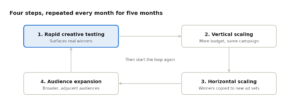
Follow the arrows clockwise: each step sets up the next, and the loop then starts over with what we learned.
Step 1: Rapid creative testing
We sharply increased the amount of testing. Every cycle, we launched several new concepts so that real winners could surface, instead of leaning on a handful of old ads that were already tired.
Step 2: Vertical scaling
When a creative proved itself, we raised its budget inside the same campaign structure. The aim was to capture as much efficient demand as possible before returns started to fade.
Step 3: Horizontal scaling
We then copied winning creatives into new campaigns and ad sets. That multiplied reach without wearing out any single audience group.
Step 4: Audience expansion
At the same time, we steadily tested broader and neighbouring audiences. They consistently did better than the narrow targeting the account began with.
We repeated this loop of testing, scaling up, scaling out and widening the audience through all five months. Each pass left the account stronger than the one before, and the gains stacked up month after month.
How the Five Months Unfolded
Results built up steadily instead of spiking overnight. That’s a good sign. It points to a process that can be repeated, not a lucky campaign.
Month 1: Scaling what worked and testing widely
We focused on scaling the product that was already winning, while testing several new audience segments in parallel. We also launched a number of new dropshipping products as tests. Some showed early promise. Others were set aside quickly.
Month 2: Doubling down
We pushed harder on the confirmed winning product and tightened how we scaled it. New creative variants kept being tested against it so the account always had something fresh in reserve.
Month 3 onwards: Winners start arriving regularly
This is when the creative-testing pipeline began turning up new winning products consistently. It allowed us to scale the budget aggressively. Monthly spend moved from roughly ₹1 lakh to ₹5.45 lakh, and reached ₹15 lakh in the fifth and final month.
Every month: A pipeline, not a single bet
Every month, several new products were tested from start to finish. That gave Grosyhub a steady flow of winners, so the business no longer hung on one hero product.
The Results, Before and After
Here is the account before we started and after five months, measured the same way both times.
| Metric | Before | After | Change |
|---|---|---|---|
| Monthly ad spend | ₹1.82 lakh | ₹15 lakh | +724% |
| Monthly revenue | ₹7.28 lakh | ₹38.64 lakh | +431% |
| Platform ROAS | 3.60x | 4.09x | +14% |
| Average order value | ₹410 | ₹542 | +32% |
| Cost per purchase | ₹113 | ₹132 | +17% |
One number deserves a closer look. Cost per purchase rose by 17%. At first glance that may sound like a step backwards, but it came alongside an eight-fold increase in monthly spend. Holding costs that close while spending that much more is controlled, profitable scaling, not a sign of waste. Platform ROAS actually improved at the same time.
Blended ROAS (MER) is available on request.
The Proof Behind the Numbers
Here are screenshots from the store and from the ad account, so you can see the results for yourself.
What the Shopify store shows
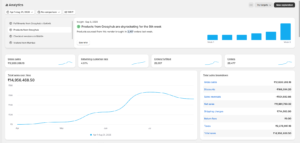
For 1 April to 31 August 2026, the store’s analytics show gross sales of ₹1.26 crore from 28,477 orders.
What Meta Ads Manager shows
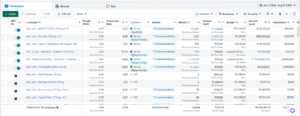
Across 55 campaigns for the same period, Ads Manager shows a 4.09 results ROAS on a total spend of about ₹38 lakh.
What Didn’t Work
Not every test was a winner, and we think that’s worth saying out loud.
Several new products were launched and never gained traction. We also tried broader audiences on those same weak products, hoping to give them a lift. It didn’t help. CPMs rose sharply, and conversions stayed flat.
When we looked closely, the cause was product-market fit, not the creative or the targeting. Once we saw that, we cut spend on those tests quickly and moved the budget to the ads that were already working. That discipline protected efficiency while the account scaled.
Lessons for Dropshipping and D2C Brands
A few lessons from Grosyhub travel well beyond this one account.
- If effort isn’t turning into growth, look at structure. Plateaus are often caused by missing systems, not missing budget.
- Don’t depend on one hero product. Test new products every month so winners keep arriving.
- Test creatives often. A steady stream of fresh ideas keeps fatigue away and keeps winners coming.
- Scale in two directions. Raise budgets on winners, then copy them into new campaigns and ad sets.
- Widen your audience. Broader and neighbouring groups often outperform tight targeting.
- Fix your tracking first. Pixel problems and a missing Conversions API leave real revenue invisible.
- Cut weak tests fast. If wider audiences only raise your costs, the issue is probably the product.
Final Thoughts
Grosyhub didn’t need more effort. It needed a system. By fixing the structural issues, testing creatives and products constantly, and scaling in a deliberate order, monthly revenue rose from ₹7.28 lakh to ₹38.64 lakh, with ₹1.26 crore generated in five months at a 4.09x platform ROAS.
The lasting gain is the pipeline itself. Grosyhub now has a steady flow of tested products and fresh creatives behind it, instead of a single product to depend on.
If your Meta Ads have plateaued and more effort isn’t helping, we’d be glad to take a look.