How Ibuki Grew From Zero to ₹20 Lakh in Revenue at 4.08x ROAS in Five Months
An Ibuki case study by Adymize | Clothing (D2C) | Meta Ads (Facebook & Instagram) | 5-month engagement
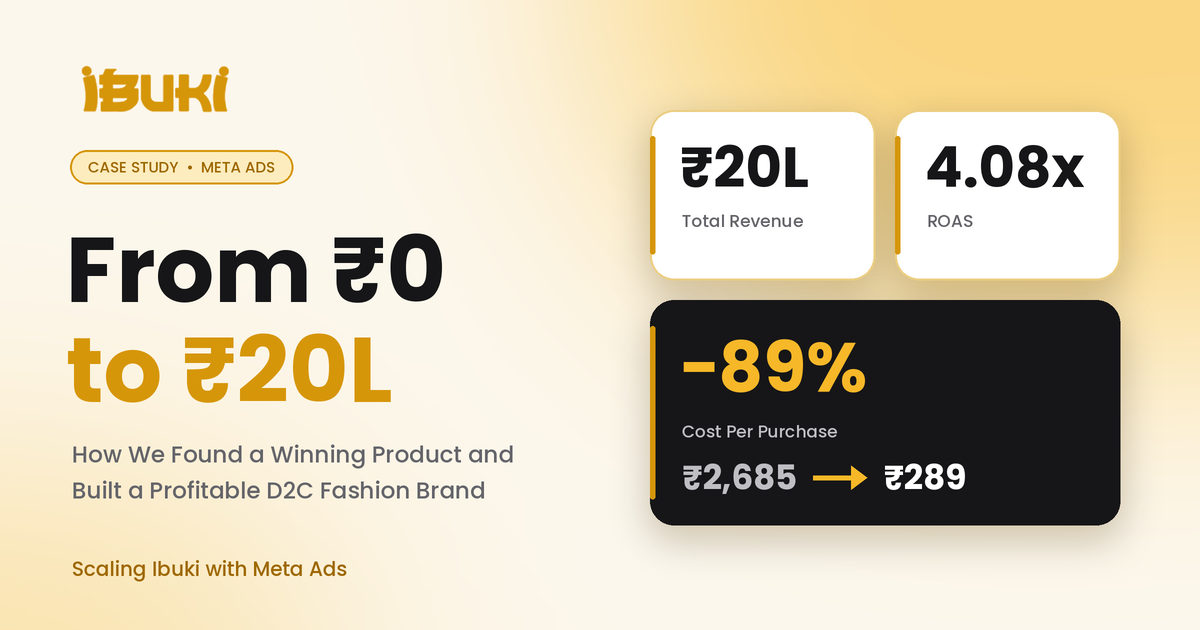
A brand-new clothing label, no sales history, no ad account to inherit, and a store that didn’t exist yet. Five months later, Ibuki had brought in ₹20 lakh in revenue at a 4.08x return on ad spend. This is the story of how that happened, including the slow, uncomfortable first stretch that most case studies skip.
Table of Contents
- Starting From Nothing
- The Real Challenge: Finding What People Actually Want
- Our Approach: The Creative-to-Scale Framework
- How the Five Months Unfolded
- The Results, Before and After
- The Proof Behind the Numbers
- What Didn’t Work
- Lessons for New D2C Brands
- Final Thoughts
Starting From Nothing
Most of the accounts we work on come with a history. There are old campaigns to study, past numbers to compare against, and some idea of what the customer likes. Ibuki had none of that.
Ibuki was a brand-new label, and Adymize was part of the journey from day one. We built the Shopify store, produced the first product creatives, and launched paid marketing from a standing start. There was no earlier return on ad spend to beat, no average order value to protect, and no revenue figure to measure growth against. The account began at zero.
That meant we weren’t fixing anything. We were building the brand’s whole performance marketing setup from scratch: the store, the creatives and the first campaign structure.
The Real Challenge: Finding What People Actually Want
When you take over a struggling account, the problem is usually somewhere in the account. When you launch a new brand, the problem is bigger and quieter: nobody knows yet what will sell.
Three things stood in our way in the early days.
No proven product. The store, the product pages and the first creatives were all built fresh. We had no signal at all about which pieces shoppers would actually pay for.
No winner in sight. The store and the ads were live, but sales were slow to show up. Being live is not the same as being wanted.
A lot of testing ahead. Before a real winning product and a creative that sold it could emerge, we needed to test a large number of ideas. There was no shortcut around it.
So the early question wasn’t “how do we scale?” It was “what is this brand’s winning product, and how do we prove it?”
Our Approach: The Creative-to-Scale Framework
We worked with what we call the Creative-to-Scale Framework. It’s a simple, repeatable system. It starts with testing creatives, moves into structured scaling, and keeps widening the audience as spend grows. It has four steps.
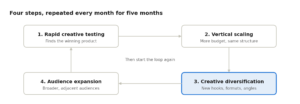
Follow the arrows clockwise: each step sets up the next, and the loop then starts over with what we learned.
Step 1: Rapid creative testing
Every cycle, we launched a healthy batch of new creative concepts. This was the step that actually uncovered the winning product. It’s also what lifted ROAS from 0.70x, where the account began, to a profitable level.
Step 2: Vertical scaling
Once we had a winning product and its first winning creative, we pushed more budget through the same campaign structure. The point was to capture the demand that product had already unlocked, while it was efficient to do so.
Step 3: Horizontal scaling through creative diversification
This is the step that carried monthly spend from ₹1 lakh up to ₹2.78 lakh, and it’s the one most brands underestimate.
A single winning creative gets tired fast once you raise the budget. The same people see it again and again, and results fade. So instead of pushing more money behind one ad, we kept making new versions of the same winning product: different hooks, different formats, different angles. These ran across new campaigns and ad sets.
It was that steady stream of fresh creative, not the product alone, that let spend keep climbing without ROAS falling apart.
Step 4: Audience expansion
Alongside all of this, we steadily tested broader and neighbouring audiences, so performance could keep improving as the budget grew.
If there’s one thing to take from the framework, it’s this: finding the winning product is what fixed ROAS. Growing the budget from ₹1 lakh to ₹2.78 lakh a month came from constantly diversifying the creative around that product. The product did not carry the weight on its own.
We repeated this loop of testing, scaling vertically, diversifying creative and widening the audience through all five months. It took the account from an early net loss to a scaled, profitable operation.
How the Five Months Unfolded
Finding the winning product took patient, disciplined testing. Scaling it took an equally disciplined creative pipeline afterwards.
Month 1: Learning the market
We researched Ibuki’s product range and studied the wider clothing market to see what was working for others. We produced the first set of clothing creatives, including influencer-led content, and launched the first ads. No clear winner emerged, so the search carried on.
Month 2: Still searching
We kept looking. That meant reworking creatives, trying new angles and testing further. It wasn’t the most exciting month, but it was a necessary one.
Month 3 and beyond: A winner appears
One product finally stood out, and it pushed ROAS into profitable territory. From there we scaled hard. Monthly spend went from roughly ₹1 lakh to ₹2 lakh, and ended at ₹2.78 lakh in the final month.
We didn’t get there by spending harder on the same ad. We got there by producing new creative variations around the winning product, month after month.
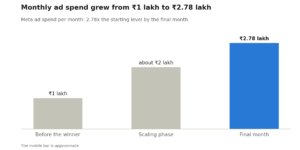
The climb was gradual, and it held up because new creative kept arriving as the budget grew.
Every month after: Keeping it fresh
Each month the team added new hooks, formats and angles for the winning product. That’s what kept the scale going without the usual drop in performance.
The Results, Before and After
These figures use the same measures, taken the same way, from before the winning product was found to the end of five months.
| Metric | Before | After | Change |
|---|---|---|---|
| Monthly ad spend | ₹1 lakh | ₹2.78 lakh | +178% |
| Monthly revenue | -₹40,000 (net loss) | ₹8.66 lakh | Loss to profit |
| Platform ROAS | 0.70x | 4.08x | +483% |
| Average order value | ₹1,936 | ₹1,380 | -29% |
| Cost per purchase | ₹2,685 | ₹289 | -89% |
One number needs a word of explanation. Average order value fell by 29%, because the winning product sat at a more affordable price point. That sounds like a step backwards, but it was easily outweighed by what came with it: cost per purchase dropped by 89%, and the number of purchases grew sharply as the creative pipeline kept feeding the product. Together, those took the account from losing money to earning ₹8.66 lakh in monthly revenue.
Blended ROAS (MER) is available on request.
The Proof Behind the Numbers
We’d rather show than ask you to take our word for it. Here are the screenshots from the ad account and the store.
What Meta Ads Manager shows
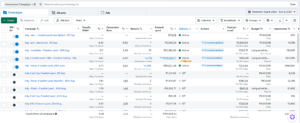
Across 26 campaigns, Ads Manager shows a 4.08 results ROAS on a total spend of about ₹4.91 lakh.
What the Shopify store shows
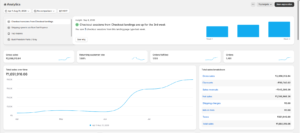
For 1 April to 31 August 2026, the store’s analytics show gross sales of ₹20.56 lakh from 1,451 orders.
What Didn’t Work
Many of the early product tests simply didn’t take off.
We also tried expanded audiences on those weaker products, hoping a wider net would help. It didn’t. CPMs shot up, and conversions stayed flat. When we looked closely, the problem wasn’t the creative or the targeting. It was product-market fit.
Once we saw that, we cut spend on those tests quickly and moved our focus to improving and scaling the best ads we had. That discipline is exactly what led us to the winning product.
Lessons for New D2C Brands
A few lessons from Ibuki apply well beyond clothing.
- Treat the first months as a search. A new brand’s job is to find what sells. Expect slow sales while you do.
- Don’t try to fix a product problem with targeting. If wider audiences only raise your costs, look at the product first.
- Cut losing tests early. Money saved from weak experiments is money you can put behind real winners.
- Don’t lean on one ad. A winning creative fades under bigger budgets. Keep making new versions of it.
- Judge the whole picture. Average order value fell, yet the business got far healthier because cost per purchase fell much further.
- Keep widening the audience. Test broader and neighbouring groups as spend grows.
Final Thoughts
Ibuki began with nothing: no history, no proven product and no revenue. In five months it became a scaled, profitable account, with ₹20 lakh in revenue at a 4.08x ROAS, cost per purchase down 89%, and monthly ad spend up from ₹1 lakh to ₹2.78 lakh.
The winning product mattered, but it wasn’t the whole story. What turned a good product into a growing business was a steady supply of fresh creative around it, and the patience to keep testing until the right product showed itself.
If you’re launching a new D2C brand and want a team that will build it from the ground up, we’d be glad to talk.