How Code Edu Moved From a Sales Funnel to a Lead Funnel and Generated 400+ Leads at ₹100 Each
A Code Edu case study by Adymize | Education & Online Courses | Meta Ads (Facebook & Instagram) | Lead generation | 3-month engagement
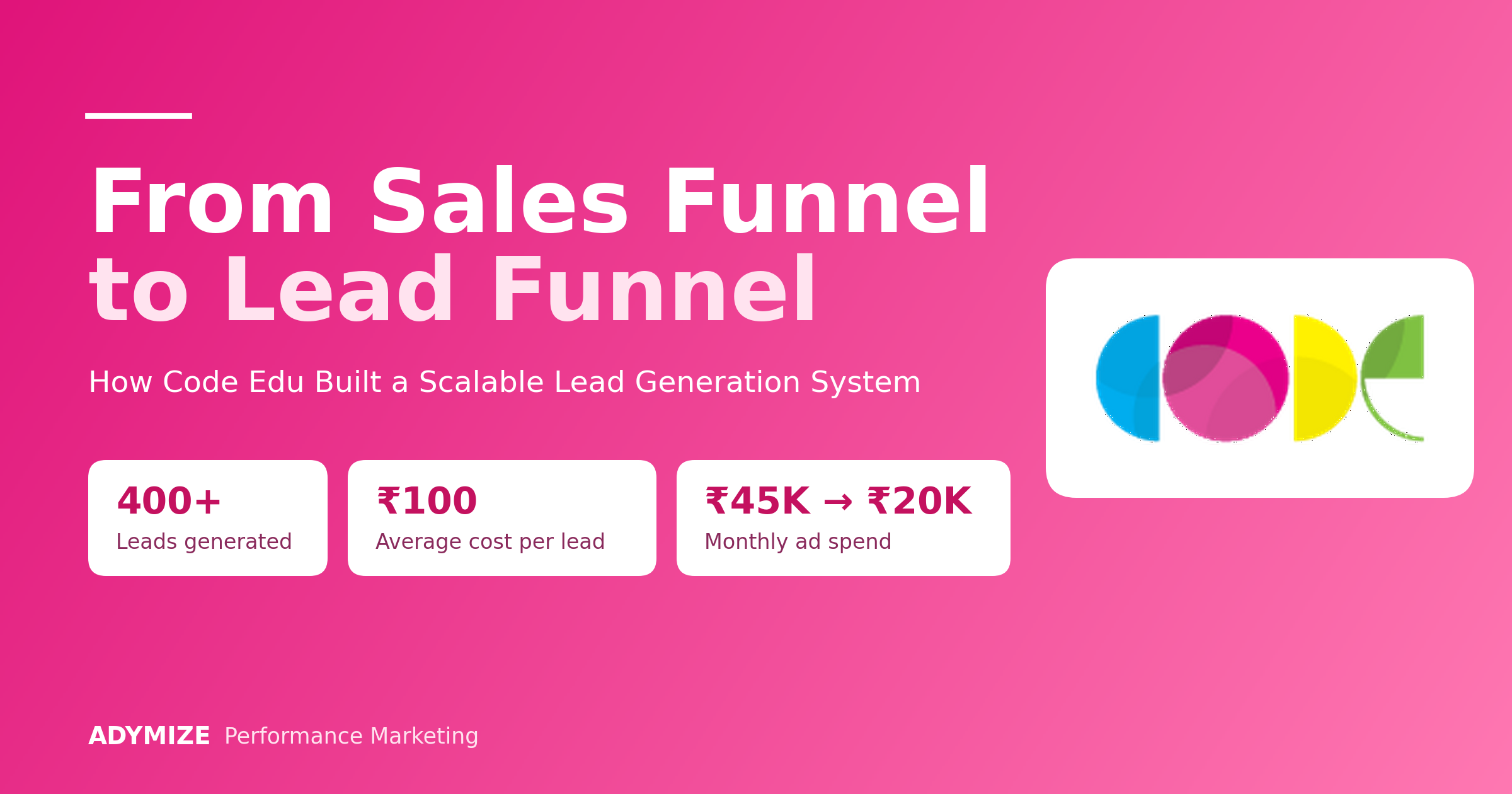
Code Edu’s ads were doing their job. People clicked, some of them bought, and the course sold. But every new customer cost more than the last, and the funnel couldn’t grow without eating into the margin. So we changed the question. Instead of asking strangers to buy on the first visit, we asked for something smaller and earned the sale later. This online course lead generation case study shows how that shift produced 400+ leads at an average cost of ₹100 each, on a monthly ad spend that fell from ₹45,000 to ₹20,000.
Table of Contents
- Where Code Edu Stood Before We Started
- Why the Sales Funnel Hit a Ceiling
- Our Approach: Capture, Nurture, Qualify, Convert
- How the Three Months Unfolded
- The Results, Before and After
- The Proof Behind the Numbers
- What Didn’t Work
- Lessons for Course Creators and Education Brands
- Final Thoughts
Where Code Edu Stood Before We Started
Code Edu ran a direct sales funnel. A person saw an ad, clicked, and landed straight on a checkout page. It’s the simplest funnel there is, and it did produce enrollments.
The trouble was cost. As the account tried to grow, acquisition costs kept rising, and each extra enrollment became harder to justify. Here is where the funnel stood:
| Where the funnel stood | Number |
|---|---|
| Monthly ad spend | ₹45,000 |
| Cost per enrollment | ₹2,200 |
| Conversion rate | 1.75% |
| Average course price | ₹2,000 |
| Monthly revenue | ₹48,000 |
The account wasn’t struggling to get traffic. Clicks were coming in. The issue was what happened after the click. Only the visitors who were already ready to buy actually bought, and everyone else simply left.
Why the Sales Funnel Hit a Ceiling
The funnel was built around one assumption: that people arrive ready to pay. Most don’t. A course is a decision that takes trust, and the funnel gave visitors no chance to build any. We found four problems that came from this.
Only high-intent buyers converted. The funnel worked for people who were already close to buying. It did nothing for the larger group who were interested but not yet ready.
Acquisition costs kept rising. With no lead capture step, every rupee of ad spend depended on an immediate sale. If the sale didn’t happen, the money was gone.
Nobody could be followed up with. A visitor who didn’t buy on the first visit was lost. There was no way to bring them back or keep the conversation going.
A ceiling on volume. Relying on instant purchases limited how much traffic could be bought profitably at scale.
Put simply, the funnel was asking for a decision before it had earned enough trust.
Our Approach: Capture, Nurture, Qualify, Convert
Instead of asking for the sale on the first visit, we built a funnel that earns trust in stages. It has four steps.
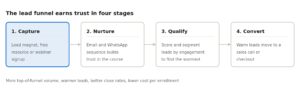
Read it left to right: each stage warms the lead a little more before the sale is ever asked for.
Step 1: Capture
We introduced a lead magnet, a free resource or a webinar signup, to capture interest before asking anyone to buy. Asking for an email or phone number is a much smaller commitment than asking for payment, so far more people say yes.
Step 2: Nurture
Captured leads moved into an email and WhatsApp sequence. Its job was to build trust and show what the course was actually worth, over days rather than in a single page visit.
Step 3: Qualify
We scored and grouped leads by how they engaged. That showed us who was warmest, so the sales team could spend their time on the people most likely to enrol.
Step 4: Convert
Only warmed, qualified leads were moved into a sales conversation or the checkout flow. By then they knew the course and trusted the brand, so the ask felt natural.
The idea behind the whole system is simple. More people at the top of the funnel means warmer leads, warmer leads close better, and better closing brings the cost per enrollment down.
How the Three Months Unfolded
We changed the funnel one layer at a time rather than all at once.
Month 1: Build
We launched the lead capture funnel. That meant setting up a landing page and lead forms, sending traffic to the capture step instead of checkout, and starting to build the nurture sequence.
Month 2: Compound
We built out the nurture sequence and added qualification. Lead scoring and segmentation went in, and the team began following up with warmed leads. This was also the month the course price changed from ₹2,000 to ₹12,000, a bigger offer that suits a funnel built around trust and a conversation.
Month 3: Scale
With the system working, we turned it into a repeatable engine. We moved spend toward top-of-funnel lead capture, kept improving how the nurture sequence performed, and focused on lowering the cost per enrollment at higher volume.
The Results, Before and After
Here is the old sales funnel next to the new lead funnel.
| Metric | Sales funnel | Lead funnel |
|---|---|---|
| Monthly ad spend | ₹45,000 | ₹20,000 |
| Total leads generated | Not tracked | 400+ |
| Average cost per lead | Not tracked | ₹100 |
| Cost per enrollment | ₹2,200 | Data not available |
| Enrollments | 25 | Data not available |
| Monthly revenue | ₹48,000 | Data not available |
| Course price | ₹2,000 | ₹12,000 |
Two things stand out. Monthly ad spend fell by more than half, from ₹45,000 to ₹20,000. And the brand now holds a growing list of interested people, each of whom cost about ₹100 to reach, instead of a funnel that only paid off when someone bought on the spot.
We want to be clear about what we can and can’t say. Enrollment and revenue figures for the lead funnel weren’t available when this was written, so we haven’t claimed a number for them. What the lead funnel did give Code Edu is a way to scale that doesn’t depend on every click turning into an immediate sale.
The Proof Behind the Numbers
Here are screenshots from Meta Ads Manager, so you can see the lead numbers for yourself.
Instant form leads
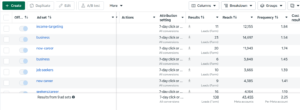
Nine ad sets brought in 108 leads through Meta’s instant forms.
Website leads
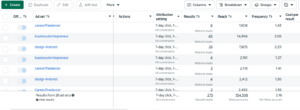
Twenty-six ad sets brought in 275 leads through the website landing page.
What Didn’t Work
Not every test was a winner, and we think that’s worth saying.
Most of the leads came from video creatives, but the videos were uneven. Only three or four of the roughly twelve to thirteen videos we made performed well. The rest didn’t earn their place.
That’s normal for creative testing, and it’s a good reminder of why the testing never stops. A small number of strong videos carried most of the result, and the rest helped us learn what to make next.
Lessons for Course Creators and Education Brands
A few lessons from Code Edu apply well beyond this one account.
- Don’t ask for the sale too early. Most people aren’t ready to pay on the first visit, especially for a course.
- Capture first, sell second. A lead magnet or webinar signup is a far easier first step than checkout.
- Follow up. Email and WhatsApp sequences keep interested people from drifting away.
- Qualify before you call. Scoring leads lets your sales team focus on the warmest ones.
- Cost per lead and cost per enrollment tell different stories. Track both, and track enrollments properly.
- Expect most creatives to miss. Make several, keep the few that work, and use the rest as lessons.
Final Thoughts
Code Edu’s sales funnel worked, but it couldn’t scale profitably. By moving to a lead funnel that captures interest first, nurtures it, qualifies it and only then asks for the sale, the brand generated more than 400 leads at about ₹100 each, on a monthly spend that fell from ₹45,000 to ₹20,000.
The real change is the system behind it. Code Edu now has a way to turn cold traffic into warm conversations, step by step.
If your course funnel is working but getting more expensive to grow, we’d be glad to take a look.